We design high-end homes that are calm, refined and responsible. Our residential work balances architectural quality with environmental performance, creating houses that are efficient to run, comfortable to live in and built to last. From the outset, we consider orientation, daylight, fabric performance and material choice to reduce energy demand while enhancing everyday experience.
Whether working on sensitive rural sites or complex urban plots, we design homes that respond intelligently to their context — integrating low-energy strategies, robust detailing and long-life materials without compromising on elegance or spatial clarity. We work closely with clients and consultants to deliver bespoke homes that are future-proofed, adaptable and environmentally sound, where sustainability is inherent in the architecture rather than applied as an afterthought.
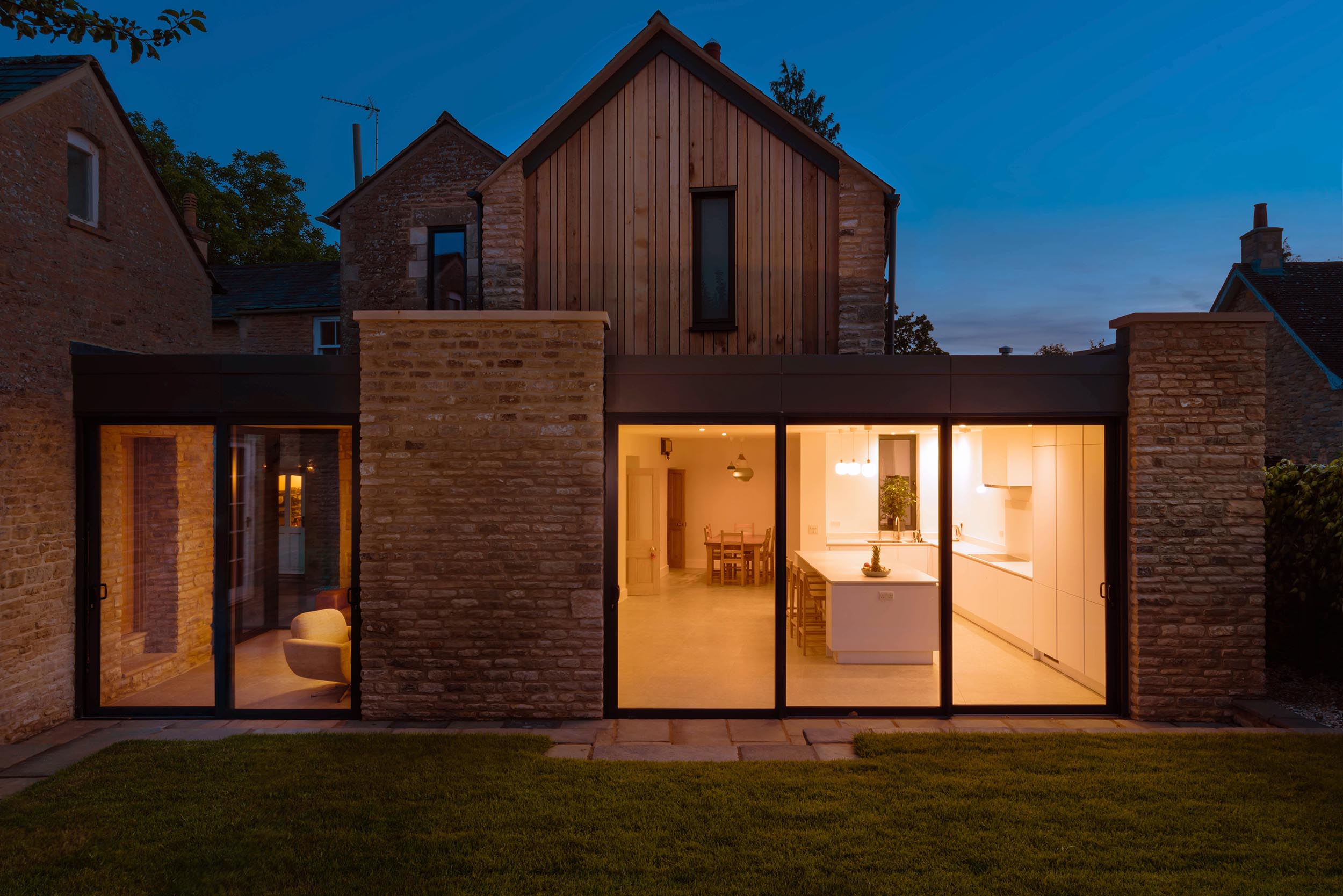
Our client’s spacious house was compromised by a constrained and uninspiring kitchen dining area that was the product of a series of ad hoc, ill considered extensions.
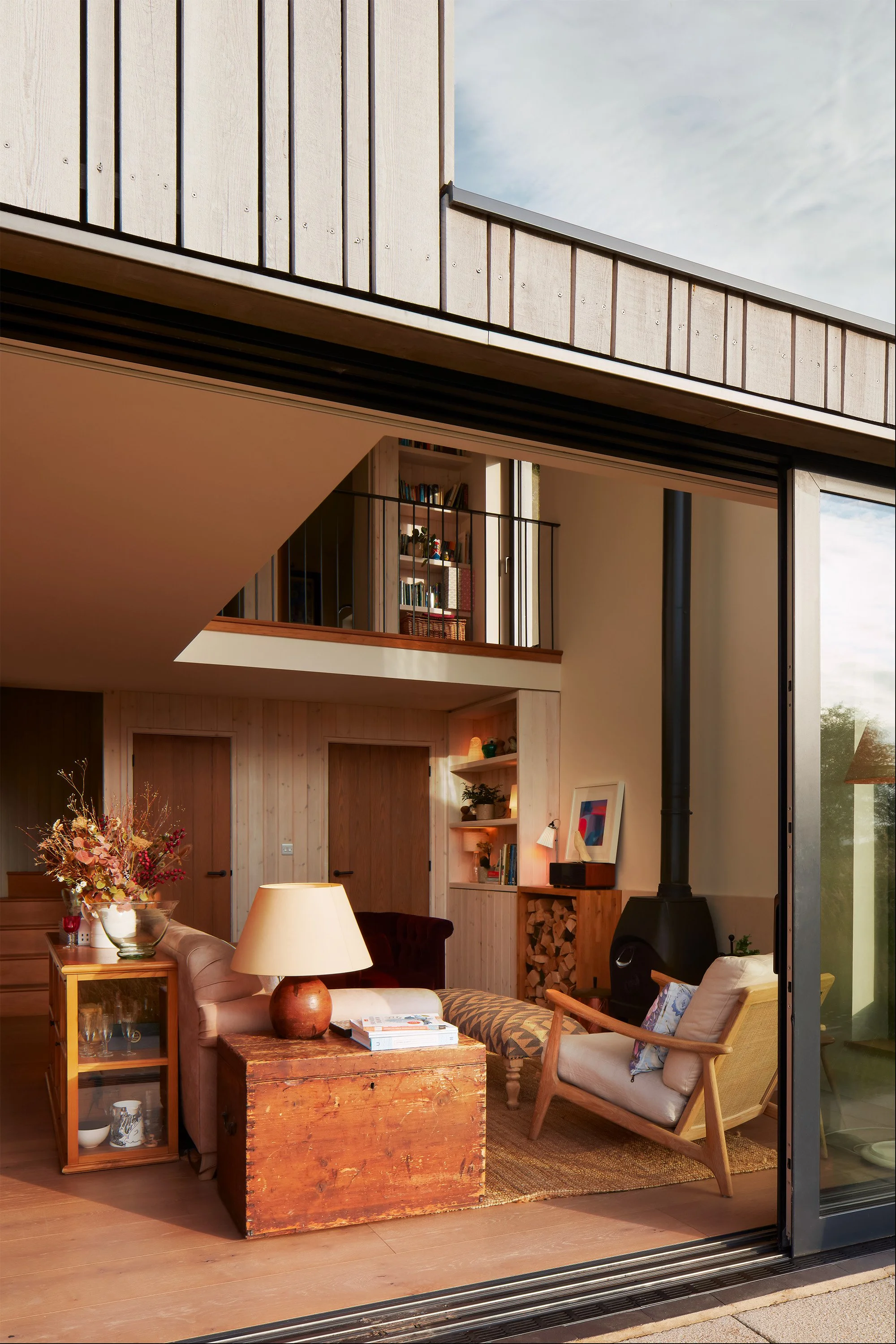
Low ceiling heights and awkward angles required a reworking of the stair, landing and first floor bathroom in order to meet the brief for a unified kitchen-dining-living space.
A desire to connect the main house to a small cottage in the garden presented an opportunity to reorientate the extension at 10 degrees to the main house, opening up the space to make best use of the site and creating a purposeful connection to the cottage.
The link building also overlooks and provides access to an enclosed courtyard that will be used for outside dining.
Photography by David Dixon
Sycamore Farm is a transformative project that breathes new life into a semi-derelict smallholding, creating a serene country retreat. The design harmoniously integrates a collection of cottages, a glass link, and a restored timber frame barn, emphasizing the blend of heritage and modernity. The layout is thoughtfully responsive to the surrounding landscape, fostering a sense of connection with nature.
Central to the project is a movement studio, designed to promote well-being and relaxation, making Sycamore Farm a sanctuary for rejuvenation and retreat from urban life.
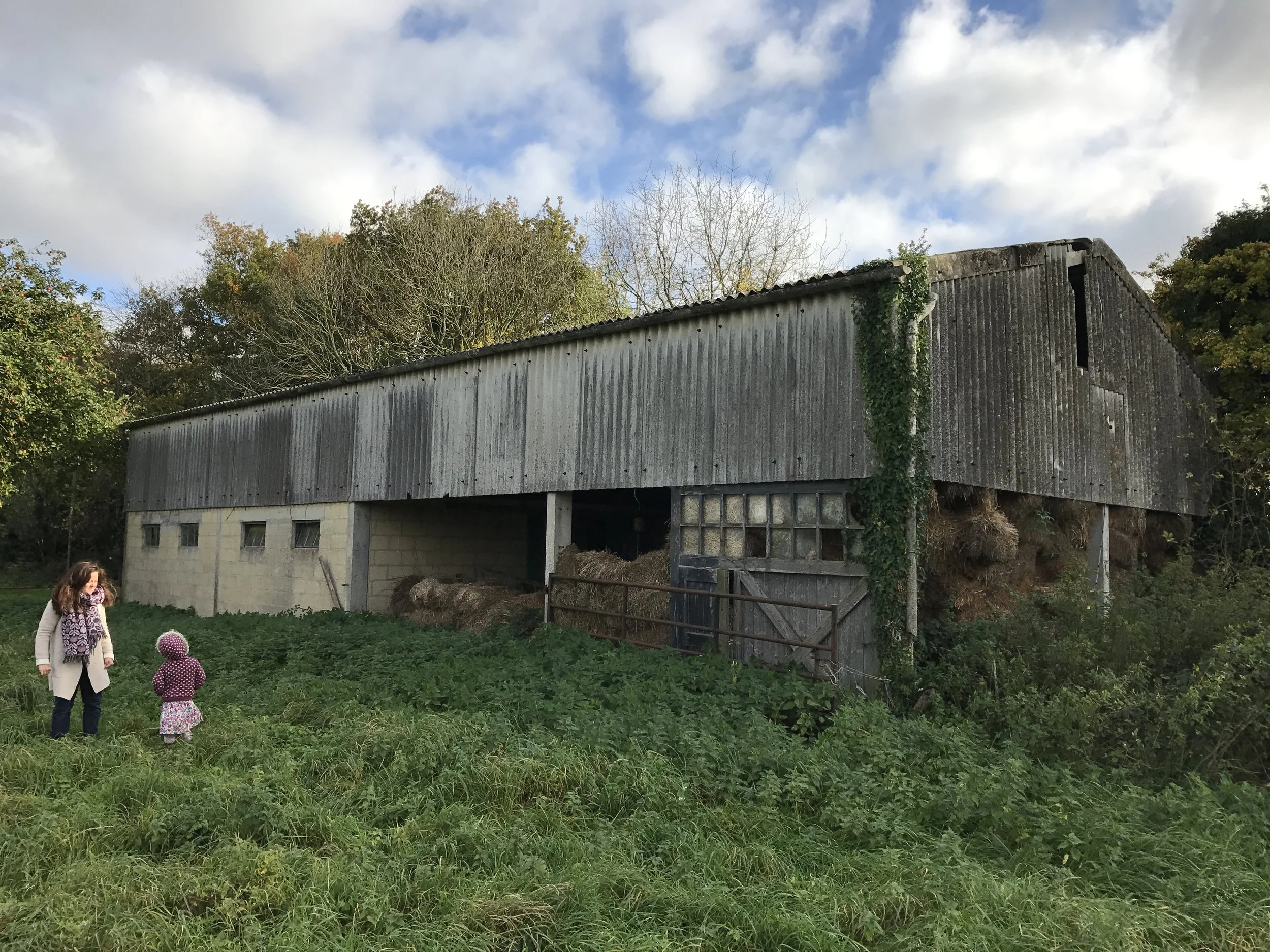
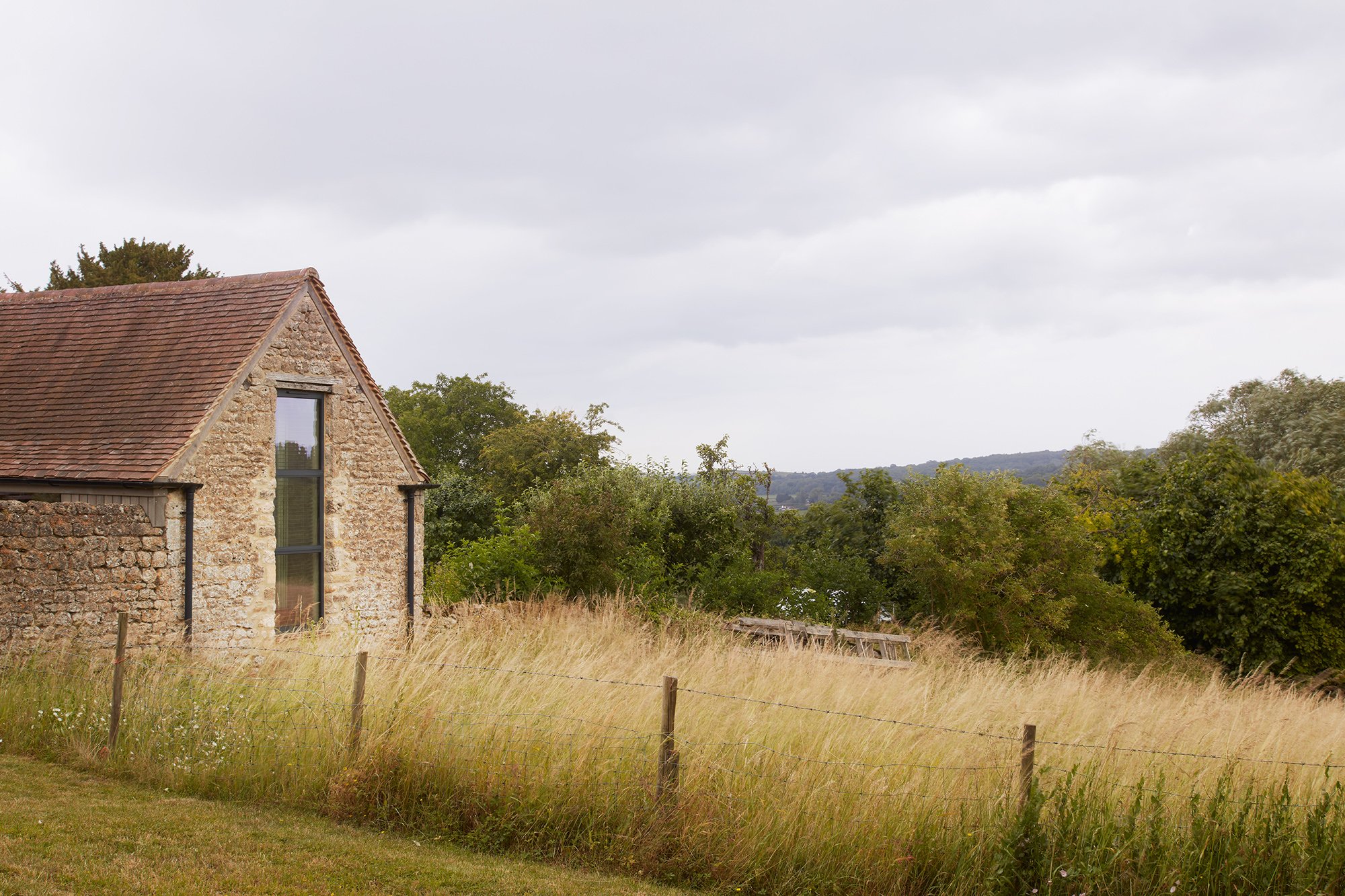
As the name suggests, The Byre began life as a cow shed, part of a retired farm in Oxfordshire. DuCroz architects obtained planning and listed building consent for the conversion and extension of the original byre into a three bedroom home.
Two adjoining stone cottages had been roughly knocked together and extended to create a labyrinthine and incoherent single dwelling.
Through rooms, bad circulation and poor headroom compromised the internal spaces along with a complete lack of a connection to the adjacent gardens.
Through careful and creative discussions with the local conservation officer, we were able to obtain approval for the extension and radical reworking of the existing building to achieve a contemporary internal layout with simple sympathetic exterior.
The layout of this classic London mews house was poorly planned and in need of updating.
The internal structure and floors were completely replaced and reconfigured to take best advantage of the single aspect. This created light, open plan spaces that make this compact three-bedroom dwelling feel expansive and luxurious.
Bespoke joinery elements provide storage and and are used to zone and screen multifunctional open plan spaces. The clients’s strong interior styling brings a unique character and feel to this family home.
DuCroz architects has recently been commissioned to undertake the design on another mews house refurbishment for the same client.
This mid-Victorian end-of-terrace house is typical of the Jericho area of Oxford.
The property had undergone only minor alterations to its original layout when we were asked to extend and reconfigure the lower and upper ground floors.
This was achieved by creating a sunken terrace at the rear, allowing both floors to open out onto the enclosed garden.
Conceived as a group of overlapping, simple brick boxes, the additions provide a study with a balcony on the upper ground floor and an extended kitchen and dining area at lower-level. The two are linked by a partial glass floor that brings a wash of light to a seating area that looks over the lower terrace.
The project involved the general refurbishment of the whole property, including new bathrooms, kitchen and utility areas.
Most of the internal walls are lined with bespoke, full-height book cases to accommodate our client's extensive collection of fine art books.
This upper ground floor apartment within a converted Georgian terrace had not been updated since the late 1980s.
Our clients wanted to open up the internal spaces to create an expansive open-plan living area with two separate bedrooms.
This required extensive structural work and complicated negotiations with the other leaseholders and the freehold management company.
We took a measured but determined approach and gained support from all parties. The project is now successfully completed.
This contemporary, single storey, rear and side extension, transformed the layout and identify of a tired and poorly extended mid century semi
Horizontal cedar cladding and dark anthracite zinc sheet make a simple yet striking contrast with the familiar dashed render finish of the original house. Internally, the layout has been reworked to provide an entrance hall and study, ground floor shower room, storage wall and a kitchen-dining-living space that fully embraces the garden.
To the side, a back door leads to a boot/utility room that provides an informal entrance and access to the main living space. At the rear, a shallow pitched roof extends out past the opening corner glazing to form a sheltered outside dining space for days of marginal weather. The simple linear form at the rear presents as a garden pavilion set in front of the traditional house.
What was originally a derelict, local council public toilet and electrical substation block was converted by Jon into a three bedroom house. Windy Corner is now a warm, characterful, contemporary family home.
Before work began, a new electrical substation had to be commissioned in the corner of the plot and shrouded with a thick masonry wall. This left enough space for two courtyard gardens and screened the substation from view.
By extending the central section of the original building, the first floor provides three bedrooms within the roof space with sloping ceilings and exposed structural timbers.
The ground floor consists of two living spaces, an open plan kitchen-living- dining area, and a separate formal sitting room.
The design retains key features of the original building. The stone mullioned windows of the old toilets now bring light into the entrance hall and open plan kitchen. The Cotswold stone external wall of the original substation remains exposed within the sitting room and shows off the carved stone lettering above the former main entrance.
A wood-burning stove, heat-exchange ventilation and under-floor heating establish an eco-friendly, comfortable internal environment. Cotswold stone, slates, and structural oak beams were sourced from the local area and combine with sweet-chestnut cladding to give a contemporary twist on the local vernacular.
Photography by John Lawrence: www.johnlawrence.org.uk
We were asked to find a site for the building of a new home for our clients in the the Witney area. After reviewing a number of options we found a small cottage with a large garden plot, tucked away down a private lane.
The cottage is locally listed; however we achieved planning permission for a substantial contemporary extension.
The house includes a galleried open-plan living space, a study, sitting room, four bedrooms, and a billiard room.
Building elements have been designed to Passivhaus standards and the scheme incorporates rainwater harvesting and air-source heat pump technology.
This hidden swimming pool has been constructed on the site of a disused tennis court in the grounds of a Grade II listed farmhouse. This sensitive location had to be handled carefully in order to achieve the required 25m swimming lane and connected indoor/outdoor pools. To screen the pool and pool-terrace from neighbouring properties, we developed an earth sheltered approach and recessed the main body of the pool into the gently rolling hillside.
Earth sheltering was fundamental to the planning strategy and ensured that the substantial building had minimal visual impact on the sensitive rural surroundings. No objections were raised during the planning process.
Ancillary accommodation includes changing rooms, a small gym/fitness studio and a social space with a kitchen, bar and access to the pool terrace. A water slide has been built into the hillside with a stepped path up through the planting, providing a discrete way of integrating landscaping and slide elements.
The demolition of a small bungalow on a long, south facing, sloping plot provided a spectacular site for a new-build five bedroom home.
This new-build dwelling in the Cotswolds reinterprets the local vernacular through a contemporary architectural lens. Designed by DuCroz Architects, the house responds to both its rural context and the constraints of a narrow infill site, delivering a carefully crafted family home that balances privacy, natural light, and a sense of place.
The form is defined by two distinct volumes: a grounded, tactile base of coursed limestone, and an upper storey expressed in warm vertical timber cladding, framed by a standing seam zinc roof and detailing. Deeply inset windows, clean eaves lines, and natural materials create an elevation that is both modern and quietly rooted in its setting.
Internally, large-format glazing opens onto a south-facing garden, allowing the open-plan ground floor to flow seamlessly between interior and exterior. Views are framed deliberately, and the spatial composition is enriched by double-height volumes and a sculpted staircase core.
Planning permission was secured through sensitive dialogue with the local authority, with the design drawing upon Cotswold traditions while making clear its own contemporary intent. The result is a calm, enduring family home that feels both fresh and familiar.
In 2022 we obtained planning permission for this self-contained garden studio building in the garden on an old granary in Berkshire.
This simple design could work in various location and was initial conceived as and off-site pre-fab proposal.
Here we showcase a selection of early stage designs that, to date, have remained on the drawing board. Some may yet make it to construction but for now we present them to show a broader range of the projects we have worked on.